
By Nicola Birchall, Barry Birchall 20 April, 2026
The story of Leading Stoker Philip Edwin “Froggie” Le Gros
A Kiwi sailor serving with the HM Royal Navy Submarine Service in the Second World War
Philip “Froggie” Le Gros was one of some 200 New Zealand sailors who volunteered for submarine service during the Second World War. This article is based on a range of unpublished sources collected by Philip Le Gros over decades, including an interview with him in 1994 as part of the Oral History project of the Royal New Zealand Navy (RNZN) museum; many newspaper clippings (most without the newspaper title and dates); a scrapbook; captions on a framed series of reproduced drawings of the exploits of the “Torbay” on which Philip served, and; comments from his son Peter. These sources were checked against published sources (footnoted) for accuracy. It is important to note that many sources were published half a century after the events of the Second World War, and are based on memory and in some cases hearsay. An article published by the RNZN paid tribute to these men, noting that while many were ratings – seamen, stokers and telegraphers, a number were officers including lieutenants, navigators and one was in command. Philip and fellow Kiwi, Bruce Bennett, were the only RNZN sailors to have participated in action earning its commander a Victoria Cross.
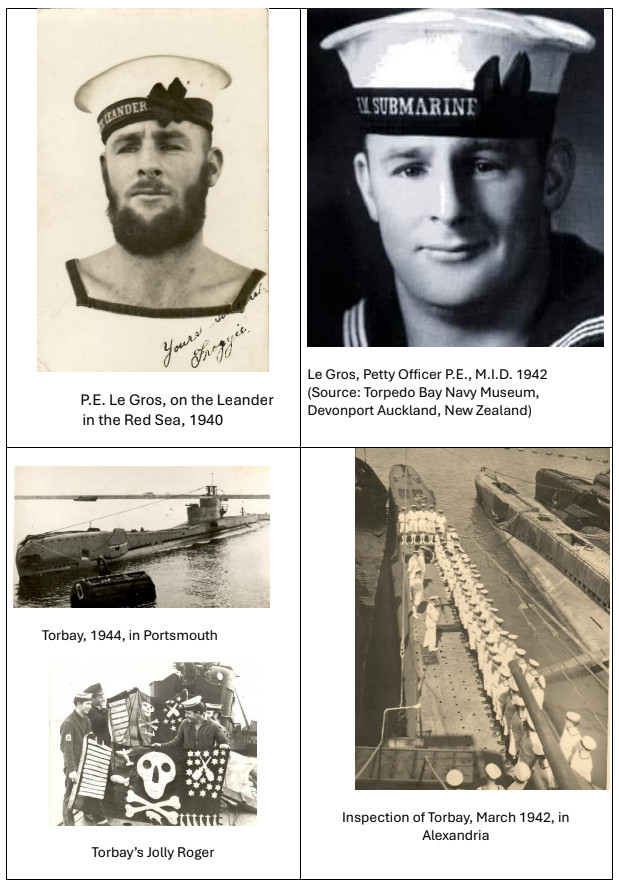
Philip was born in 1918 in Taumaranui, one of eight children. With farming in the doldrums and little work available, the family moved to Hawke’s Bay. He went through school with Bruce Bennett in the small town of Wairoa, where they learned, played and swam together as boys. He left school at age 13, as was common, and had great trouble finding work. Initially, he was working in scrub-cutting, and did some farm work. He then joined the fabricating crew on the Mohaka viaduct, said to be the highest viaduct after the “Sydney Bridge”, where he worked as a riveter, rising to the position of Foreman Riveter. It was stories about sailing around different parts of the world by some of the men working as riggers on the viaduct that piqued his interest joining the navy in the field of engineering. He joined the navy, training on the “Philomel”, and while still in training war broke out. Just before war broke out, he was deployed to the “Leander”, a light cruiser transferred from the Royal Navy to the RNZN. In the navy many were given nicknames. His nickname Froggie (or Froggy) was given on account of his French-sounding surname Le Gros.
From 1939 he was with the Leander for two years. Early in 1940, sailing on the Leander, he left New Zealand and joined the Anzac escort to the Middle east, convoying shipping in the Red Sea and the Mediterranean. For five months, his ship chased surface German Raiders in the Indian Ocean, destroying two raiders and one supply ship. When serving in the Mediterranean, engaged in the Beirut operation, the Leander was dive-bombed for anti-aircraft activities. His job on the Leander was to look after two huge boilers, about 30 feet high, that provided the steam that powered the Leander. The boilers would pulsate when the speed of 35 knots was reached. He said he was very frightened because if a torpedo hit, he would not be able to escape. Philip’s son Peter recounted that having encountered enemy fire for the first time, Philip unsuccessfully requested a move to another position on the boat.
While operating in the Mediterranean, a notice went up inviting New Zealand ratings and stokers to volunteer for submarine service. The vulnerability of his position in the Leander in the event of being torpedoed prompted Philip to do so. An item in a local newspaper reported that Le Gros was the first sailor of the RNZN to serve in submarines; he was certainly among the first. About six volunteers were then taken to Alexandria and put on the “Medway”, a submarine depot ship. An article published in the New Zealand Weekend Herald in September 2001 noted that New Zealand volunteers were usually assigned to a vessel in pairs for company. He and Bruce Bennett, his friend since boyhood, were assigned as Stokers to the Torbay, which was moored alongside the Medway. The Torbay was one of 13 submarines in the flotilla. After one patrol of about one month, five of the 13 were missing.
Leading Stokers Le Gros and Bennett served together in submarines for more than four years, much of it on the Torbay. The Torbay was regarded as one of the most successful in the fleet in terms of the numbers of ships sunk and airplanes brought down (termed “kills” by the crew). They were on the Torbay in the Mediterranean for two commissions, which they joined in mid-1941, at the start of their first commission. Both subsequently served on the “Trespasser”, “Templar” and “Stoic”, and in 1945, on the surrendered German U-776. By then the war in Europe was over, and the RNZN requested its loaned personnel be returned. For Froggie, his war-time navy service including on the Leander, lasted from 1939 to 1945. In that time, he had only one period of leave for two months, in 1944. Looking back, he said enjoyed his time in the submarines. It was very hard work, but he made a lot of friends, and everyone was in the same situation. He claimed he “probably did more sea time than any other bloke in the New Zealand Navy”.
Life on board a submarine
Philip Le Gros was interviewed for a local newspaper in 1942. As Stokers, Bennett and Le Gros were working on Diesel engines, pumps and vents. They did not see much of the action because they were in the engine room. They described the life of a submariner as “the grandest life” and were pleasantly surprised at the food which they said was the best. They reported they were “the happiest crew and have a great captain with whom the boys would go anywhere”.
Based on his oral history recorded half a century later, the realities of submarine life he described were far from grand, however. In contrast with the Leander where he was one of a “great crowd of men”, there was only a small crew on the Torbay, closely packed in bunks alongside each other. Even the officers were in ordinary bunks. All the food needed for a patrol would be packed into the sleeping areas, including in the escape hatch, where water present would make the bread and potatoes stowed there mouldy. At first, crew had their own bunks, but as the war progressed and more equipment was loaded into sleeping areas, the crew had to hot-bunk. Submarines were uncomfortable as they “rolled like anything”. There were five officers among the crew of 60, including an Engineering Officer.
When at sea there were three watches, and the crew did two hours on and four hours off round the clock, whether on surface or diving. With the engines pounding, the noise of the compressor alongside one’s head and the smells from the engine room, the stokers got very little sleep. Meals had to fit in around watches and shifts and time of serving plus type of meal (breakfast, dinner) were a bit “topsy-turvy”. Breakfast could be at midnight, dinner at 8.00 in the morning. He said the cook was amazing in producing great meals in difficult circumstances, alongside his other duties. The men stunk of diesel, fumes and bilge water. On board they couldn’t wash properly, just used a wet facecloth. Similarly, they couldn’t do any laundry. Body odour was high, but everyone smelt the same. On return to Alexandria at the end of a patrol there was a rush for a hot bath on the Medway. Even in port, there was little opportunity for rest and recreation because the risk of attack remained, and sometimes they went back on patrol ahead of schedule to cover for lost boats.
There were ten stokers. Philip’s first duty was on the engines, quickly closing the exhaust system when diving to prevent water running back up the pistons, constantly checking temperatures, standing by for the next command. Later, Le Gros was working in the control room, handling the diving levers to dive on command, a role in which “you had to be very quick on the uptake” to save seconds when diving. In the control room he was also raising and lowering the periscope on command.
Engaging with enemy vessels meant constant activity and fear. An example was the sinking of a tanker on its way to supply Rommel’s operation in Libya. The entire operation lasted five minutes 43 seconds from the time of surfacing to engage, to diving underwater. The moment of greatest tension is when a “fish” (torpedo) is fired off, as they waited for the explosion. On his first patrol with the Torbay, a U-boat laying mines was spotted. Six torpedoes were fired, all hit and the force of the explosion of the mine-laden U-boat lifted the Torbay 30 feet from the water.
Conditions on board could be appalling. For example, the Torbay set off on its second patrol to Crete with the New Zealanders on board on June 28, 1941, when the Torbay left Alexandria. The crew had been thrown together from various commands. Many of the Torbay crew had by then been at sea for more than five months. The heat was sweltering. They were exhausted and shell-shocked. Working two hours on duty and four off, the crew were perpetually short of sleep. There were constant attacks and counter-attacks, dives and surfacing, and with each attack came the depth charges, each sending shudders through the submarine, shattering instrument glass, setting off leaks and alarms. Depth charges meant lying low and hoping for the best; some men played cards, others prayed.
During one patrol, Le Gros reported on a rattle he heard that needed to be checked out when they next surfaced. They discovered they had been towing a mine, probably for a week or so. Fortunately, they were steaming ahead, but had they needed to reverse it could have spelled the end of the Torbay and her crew. On another the crew discovered a torpedo had become stuck in the firing shaft. Not knowing whether it was still alive, they tried to manually dislodge it without success, but did manage to fire it off.
In the summer of 1942, the Torbay was on patrol in Norway for three weeks. It never actually was dark, at night just a pale moonlight, making surfacing to recharge batteries more hazardous. It was very cold, and when the Torbay surfaced to recharge batteries, was quickly covered with ice. It was a very cold, rough and uncomfortable patrol in rough seas. At the other extreme, nine months later they were in another submarine en route to Colombo via the Red Sea. Fans did little to cool the temperatures and the stokers worked naked, sweat streaming off them.
Le Gros and Bennett served under two different commanders in their four years on the Torbay. Miers had assumed command of the Torbay in 1940, and was the commander when the New Zealanders joined the crew. Robert J. Clutterbuck took over the Torbay in October 1942, after she was refitted in Devonport Dockyard. The two commanders couldn’t have been more different. While Miers was charismatic, loud and rumbustious and prone to loud swearing, Clutterbuck was shy, quiet and diffident, and spoke politely.
At the start of their first commission, Philip Le Gros recalled that when someone heard he and Bennett had been assigned to the Torbay, he said “Don’t go on that, the skipper is mad! He’s mad!” Le Gros described Miers as getting the Torbay into trouble, but he always got them out of it again. He was a disciplinarian, had a fearsome temper, but also inspired awesome loyalty among his men. However, both were effective in their missions. In his letter refuting war crimes, Vice-Admiral Sir Ian McGreach suggested Miers’ main fault could be in exaggerating his exploits. He summarised the success of the Torbay crew under the two officers. When under the command of Commander Miers between March 1941-April 1942, the Torbay sunk a submarine, six supply ships and seven sailing vessels, and damaged an additional four supply ships. After Lieut. Clutterbuck took command, from February to November 1943 while patrolling the Eastern Mediterranean and Aegean Seas, the Torbay sunk eight supply ships and one sailing vessel, and damaged a supply ship and a floating dock. Captions on a framed series of reproduced drawings stated: “The “Torbay’s” dare-devil exploits have become almost legendary, for in her year’s work she sank five supply ships, two rankers (probably three), one destroyer probably sunk and another badly damaged, as well as 21 auxiliary enemy craft sunk.”
Patrols and exploits on the Torbay
At the time when Le Gros and Bennett joined the Torbay crew in March,1941, the war looked very bleak for the British. The Americans hadn’t yet entered the war, and Britain stood “alone”in the war against Nazi Germany and the Axis. Alone, but supported by large numbers of fighting men from Canada, Australia, India, Rhodesia, South Africa and New Zealand, colonies and former colonies all. The submarine fleet was deployed to strangle German supply to its troops in North Africa and in this, the Torbay was among the most courageous and successful. The Navy was losing 50 per cent of its submarines in the Mediterranean.
The first patrol in their first commission of about one month was around Tobruk after leaving Alexandria, where there was a lot of shipping heading south from Sicily and southern Italian ports, and “pickings were good”. Sailing in the area was made difficult due to unstable water temperatures and shallow waters, and it was there where Le Gros first experienced depth charges. From there they sailed up the Albanian coast where they blew up a U-boat that was laying mines. On their way back to Alexandria, they sunk another couple of smaller vessels.
In the first three weeks of the second patrol, the Torbay sunk a U-boat, a tanker, a merchant ship and eight small vessels, and in return, the crew endured 81 depth charges. The Torbay was then ordered to prevent the landing of German troops, ammunition, fuel and stores on Crete. In early July 1941, hundreds of British, Australian and New Zealand troops were hiding in the mountains of Crete after German paratroopers had taken control of the island. By the time Crete was reached, the Torbay was low on ammunition. The Torbay surfaced to see a convoy of German vessels approaching Crete. They engaged, and in the case of one of the vessels loaded with troops, the ship claimed to be Greek, not German, and made to surrender. As the Torbay landing party drew alongside to board, a German crew member prepared to launch a grenade and another individual firing from the wheelhouse. At the same time, seven soldiers launched a dinghy and left the ship. Commander Miers ordered the ship be sunk. He is alleged to have ordered that the soldiers in the dinghy be machine-gunned; other sources claim it is not known who issued that order. The incident was fully reported and investigated, and Miers vindicated. The Torbay was under threaten by a German vessel which had acted treacherously in claiming wrongly to be Greek and by aircraft overhead. To have allowed the soldiers to reach Crete would have prejudiced the mission. To have delayed diving exposed the Torbay to Luftwaffe fire. Almost half a century later, an allegation was made in a book that this was a war crime, on the grounds of shooting prisoners of war with claims the crew was close to mutiny. It triggered considerable correspondence in the media, arguing that they were not in fact prisoners, nor had the ship and its crew genuinely surrendered. The Daily Mail newspaper reported on its investigation into the allegation in 1989, for which it had interviewed surviving crew of the Torbay; one of the three was Stoker Le Gros. None of the three were on deck at the time (Le Gros was fully occupied in the engine room) and none supported the claims of near-mutiny, and their accounts supported Miers’ log.
Between August and December, 1941, the Torbay carried out several hazardous rescue missions at night of soldiers from Crete’s south-west beaches. Evacuating the men was a risky operation because there were no harbours, the Torbay was very close to shore and as close to grounding on beaches as was possible, but not at anchor. On one evacuation mission Le Gros swam ashore with a rope and made it fast so that the many soldiers who couldn’t swim could guide themselves to the Torbay. With sixty or seventy extras on top of the crew, the Torbay was absolutely crammed, putting an enormous strain on its systems and air availability. They got as far away from Crete as possible before surfacing, and 30 hours later disembarked the men in Alexandria. In total, 130 officers and men were rescued of whom 121 were Commonwealth including 62 New Zealanders.
The next patrol in November 1941was a Commando patrol, and involved the Torbay and the Talisman transporting about 40 commandos to the northern tip of Tunisia in an attempt on Rommel. The two submarines waited off-shore from the drop-off point, expecting the commandos back in some 12 hours. Le Gros was sent ashore to check that the fol-boats were adequately hidden in the sand dunes. The commandos returned but were spotted by the enemy and none made it back to the submarines; some were shot, and others made their escape through the Long Range Desert Group. From there they went up to the Albanian coast where they attacked a gun installation.
In February 1942 the Torbay set off on patrol under orders to destroy shipping bound for to Greece, Crete and North Africa. Enduring poor rough seas and poor visibility, they tried but failed to sink some ships and after a failed attack on a destroyer were themselves pursued for a few hours. that they saw through the periscope quite a large convoy of Italian ships heading north to enter the Corfu harbour, and followed the convoy for about 30 miles through a narrow channel. By the time the harbour was reached the batteries were nearly collapsed, so they had no choice but to surface to recharge, in bright moonlight, surrounded by enemy ships and having to dive to avoid being spotted by patrol boats and motor launches. By morning, many of the ships had left the harbour using another channel, and a decision was made to attack the remaining ships at anchor, at dawn. They sunk two supply ships, then headed back down the channel pursued by E- boats, destroyers and aircraft and harassed by depth-charges. They made good their
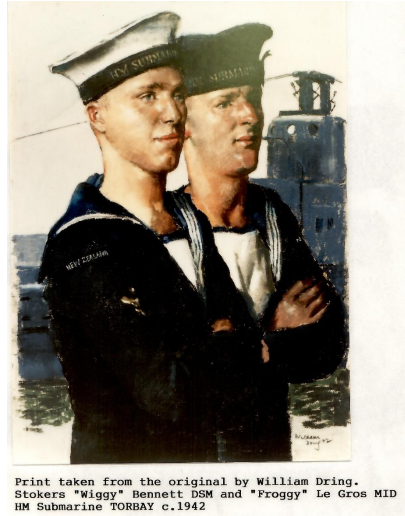
escape under-water before the channel was closed by the boom defence vessel. This was the action that best illustrated Miers’ pugnacious courage and confidence. For the 17 hours the Torbay remained in the harbour, hunting and being hunted, having to surface to recharge the batteries, dive again to avoid being seen by a patrol boat, they endured 40 depth charges. It was for this action that Miers was awarded the V.C. and 23 of his crew decorated, including a DSM for Bennett and Mentioned in Despatches for Le Gros. (Le Gros wasn’t sure whether his M.I.D. was for the Corfu action or the earlier action of going ashore in the commando patrol.) He thought it was for being control room operator during the V.C. action, manning the periscope controls. When Commander Miers was invited to Buckingham Palace to receive his V.C, he insisted that the honour was extended to all his crew; the Palace agreed. Usually, ceremonies of awards presentations were conducted separately for officers and men. Commander A.C. Miers V.C. commissioned a formal portrait of Leading Stokers Bennett and Le Gros which he had framed and presented as a token of thanks by the RN for the volunteers from the RNZN for submarines from 1941, and also on account of their being the first and only RNZN personnel to have taken part in a VC action.
In April 1942 the Torbay set off for her final patrol under the command of Miers, with some success at disrupting shipping and sinking ships, and found herself in “desparate danger” pursued by submarines, aircrafts and small vessels, having to remain submerged while low on battery and air. In May 1942 the Torbay returned to Portsmouth for a refit, via the heavily mined Strait of Sicily and with a brief stop at Gibraltar and the chance for the crew to go ashore. The arrived on the English coast to a tremendous welcome, flying the Jolly Roger displaying their victories, and cheered on by the crowds lining the coast from Southsea to Portsmouth.
During the refit, that lasted some six weeks, the Torbay was fitted with air warning radar and Oerlikon guns. Commander Clutterbuck took command after the refit, only a nucleus of the Torbay’s Mediterranean crew remaining, with most being redeployed to new or refitted submarines. They headed to the North Sea on a “shake down cruise” to do torpedo runs on a lightly escorted German convoy, then allocated to U-boat patrol. They cruised towards Murmansk, without actually entering the harbour. By then they got orders to return to the Mediterranean as quickly as possible. The crew had five day’s leave in England on route, while the New Zealanders were the retard crew. Everybody returned late and all were on charge as a result. By the time they reached the Mediterranean demotions left them with fewer Petty Officers and other ranks. Back in the Mediterranean, shipping activity had died down but there was a lot of aircraft traffic. It was more difficult getting the hits on shipping as before.
By September 1944, Le Gros and Bennett had left the Torbay for the Templar, to Trincomalee in Sri Lanka. They were asked to go on patrol in the Malacca Strait, but had already been granted leave by the Admiralty, the first since joining up. After two month’s leave, they were sent back to England where they went through the Petty Officer’s course, overdue by about two and a half years. The next assignment was a self-refit on Stoic in Portsmouth, in 1945. By then, the war was coming to an end.
A few days before the war ended, they were ordered to pack their kit, and were transported aboard a destroyer to take over the U-776, a surrendered U-boat. Le Gros said they needed to be very careful in case it was sabotaged. Some of the crew of the Graf, a captured U-boat used in the RN, and for the first few days some of the German crew, helped out as the new crew learned to operate the U 776. It was subsequently stripped and scuttled. He said he and Bennett didn’t spend much time on her because by then the war was over and they had orders to be returned to the RNZN.
Aspects of submarine service that was different for the New Zealanders compared with British sailors
There is a photograph taken of the New Zealand High Commissioner meeting Bennett and le Gros in 1942 in England, presumably when the Torbay was having its refit. Son Peter recounts that he was checking that the New Zealand sailors were being treated fairly by the RN.
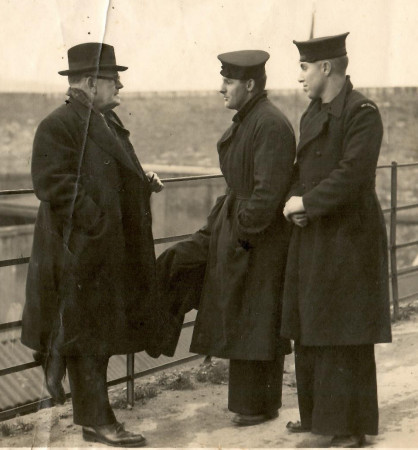
The distance from New Zealand affected ability to take leave. After the Torbay received orders to return to the Mediterranean from the North Sea as quickly as possible, while English crew were given leave when back in port, Le Gros and others who were not locals stayed on board as the “retard crew”. He said they didn’t mind.
By mid-1944, Le Gros and Bennett had left the Torbay and was on the crew of the Templar. He had had no leave since the start of the war, five years previously, and was to return to New Zealand with Bennett for some leave. He said it wasn’t so bad for Bruce Bennett, as he had joined the navy after he had and had had leave before joining the Leander.
Transferring from the RNZN to the RN submarine service two years into the war could have affected training opportunities. On signing up, they should have undergone Davis escape procedures, but Philip said they were so short of men no training was given. Philip also explained that he had not progressed from the rank of Leading Stoker, because he had had no opportunity to sit exams, despite having more than enough sea time. This is supported by evidence of only two certificates being awarded while in the Royal Navy during those four years. The first was for the Auxiliary Machinery Watchkeeping Course, 28 October 1941, on H.M.S. Torbay, and the second the Passing Certificate for Stoker Petty officer, 21 February 1945. He and Bennett had been sent back to England following leave in 1944, where they went through the Petty Officer’s Course. By then, the war was nearly over.
A third issue affecting the New Zealanders in the submarine service was returning to New Zealand after leaving the RN. In his final operation as a submariner to take control of the U-776, Le Gros said he didn’t spend much time on her as by then the war was over and New Zealand loan personnel had to be returned; marching orders were received.
The journey back to New Zealand was long and arduous. After a month’s wait in Fort Blockhouse (a historical military establishment in Gosport, Hampshire, UK), they boarded a fleet sweeper called the “Wave”. This took them as far as Colombo, reached some six weeks later. From there they needed to look for ships to take them another step along the way home. They picked up various ships, including an aircraft carrier, and thus they got to Bombay, to Singapore, possibly to Sydney and finally reached Christchurch just in time for Christmas. From Christchurch Philip needed to make his way north to his family, which he reached on January 6th. His first action then was to marry. The homeward journey would have taken half a year.
In the post-war period
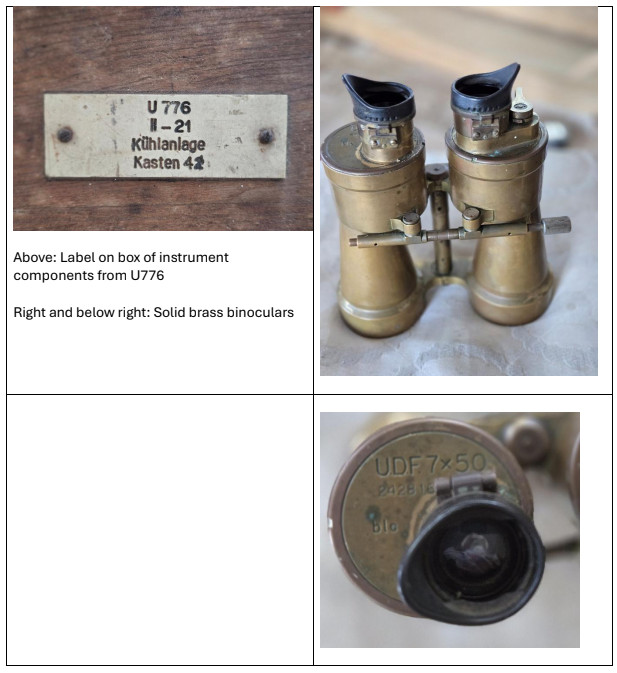
According to son Peter, after boarding surrendered U-boats and before scuttling the vessel, the crew souvenired its instruments, and Philip sold the contents of a small box of chronometer components on return to New Zealand, enough to pay for a new car, a Ford Prefect. Peter still has that car. Peter also has a heavy, bronze pair of binoculars from the U-boat, of the type that was fixed to the deck of the U-boat, not hand-held, allowing the commander to spot enemy vessels. Few of these instruments remain. There is also a world map showing where U-boats were deployed through in the world’s oceans.
Following the war, Philip stayed in contact with Commander Miers for the rest of his life. Miers stayed at the Le Gros home on visits to New Zealand, and Le Gros family members visited the Miers when in the UK. He also remained in contact with Paul Chapman, Second Officer on the Torbay who, it turned out, was a distant relative of Froggie through his great-grandmother. He was the author of “The Torbay” and sent Philip a signed copy.
After returning to New Zealand, he first served in the corvette HMNZS ARBUTUS, sailing through the Pacific Islands repairing radio stations that Japanese forces had damaged and rendered inoperable. He held other roles including coxswain of the RNZN liberty boats, and chief fireman on Devonport Naval Base. Philip Le Gros retired as a Petty Officer from the RNZN in 1951. He remained an active member of the Submariners’ Association, New Zealand Branch.
Footnote
Main source: Royal New Zealand Navy Museum: Oral History. Interview with Petty Officer P.E. Le Gros RNZN (Rtd), M.I.D., December 1994
Additional sources:
Gamp VC. The wartime story of maverick submarine commander Anthony Miers. Brian Izzard, 2009, Haynes Publishing, UK Submarine Torbay. Paul Chapman, 1989, Robert Hale Ltd, UK